Live Sessions
2 Months
40+ Hours
Lifetime Access
Build a strong foundation in FEA, then progress through structural, thermal, dynamic and fatigue analysis.
Master essential FEA concepts and advanced modelling techniques.
Identify unrealistic stresses and validate simulation results.
Apply multiple loading and unloading conditions accurately.
Understand plasticity, material hardening and plastic strain.
Handle complex assemblies with linear and nonlinear connections.
Understand how FEA solvers work behind the software.
Identify convergence issues and apply effective debugging strategies.
Identify load paths and critical regions before simulation.
Understand component geometry, mechanisms and functionality.
Interpret simulation results and present findings confidently to clients.
Define project scope, methodology, physics and estimated effort.
Prepare for technical interviews and independent industry projects.
Review lecture-by-lecture topics, project scopes and the full learning roadmap before enrolling.
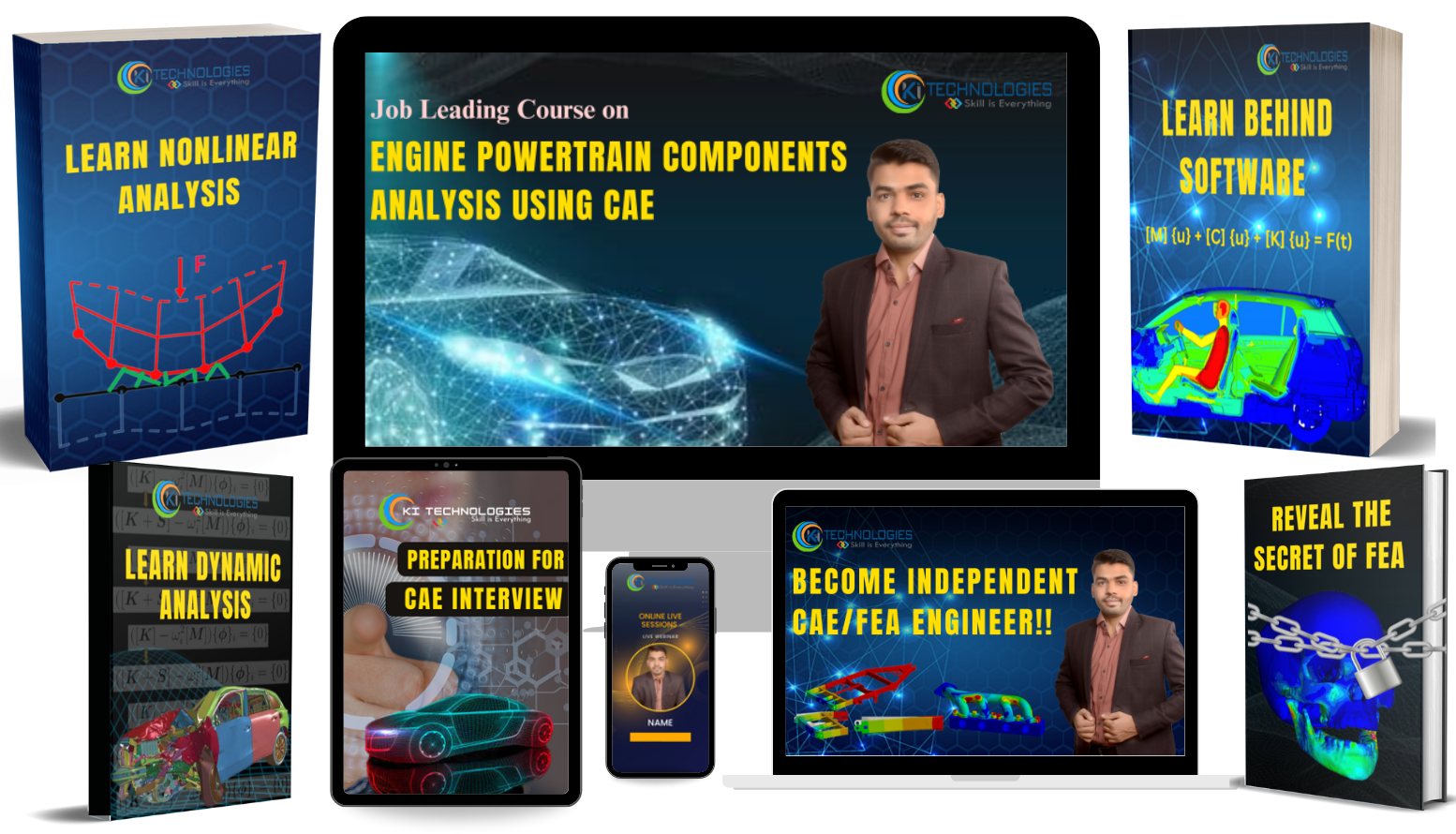
Master engine powertrain component analysis using CAE/FEA in 2 months. Learn through recordings of real live classes, industry projects and expert mentoring.
Build a strong foundation in FEA, then progress through structural, thermal, dynamic and fatigue analysis.
Stress, deformation and load cases.
Contact setup and convergence.
Plasticity and material models.
Instability and critical loads.
Thermal stress and expansion.
Time-dependent heat transfer.
Modal response and resonance.
Forced frequency response.
Time-varying structural loads.
PSD and statistical response.
Fatigue life and damage concepts.
Review lecture-by-lecture topics, project scopes and the full learning roadmap before enrolling.
See how real components are assessed, from setup to interpretation and reporting.
Strength, buckling and fatigue case studies.
Thermo-mechanical simulation and result interpretation.
Steady-state and transient thermal analysis.
Cyclic loading and non-linear material behaviour.
Modal, shock and random vibration studies.
Dynamic strength, load cases and harmonic response.
A senior FEA consultant with 16+ years of industry experience in automotive, powertrain, EV, off-highway and industrial machine components.
His work spans structural and non-linear simulation, thermal and thermo-mechanical analysis, dynamics, fatigue and durability. Learn how to approach engineering problems using practical theory and project-based methods.
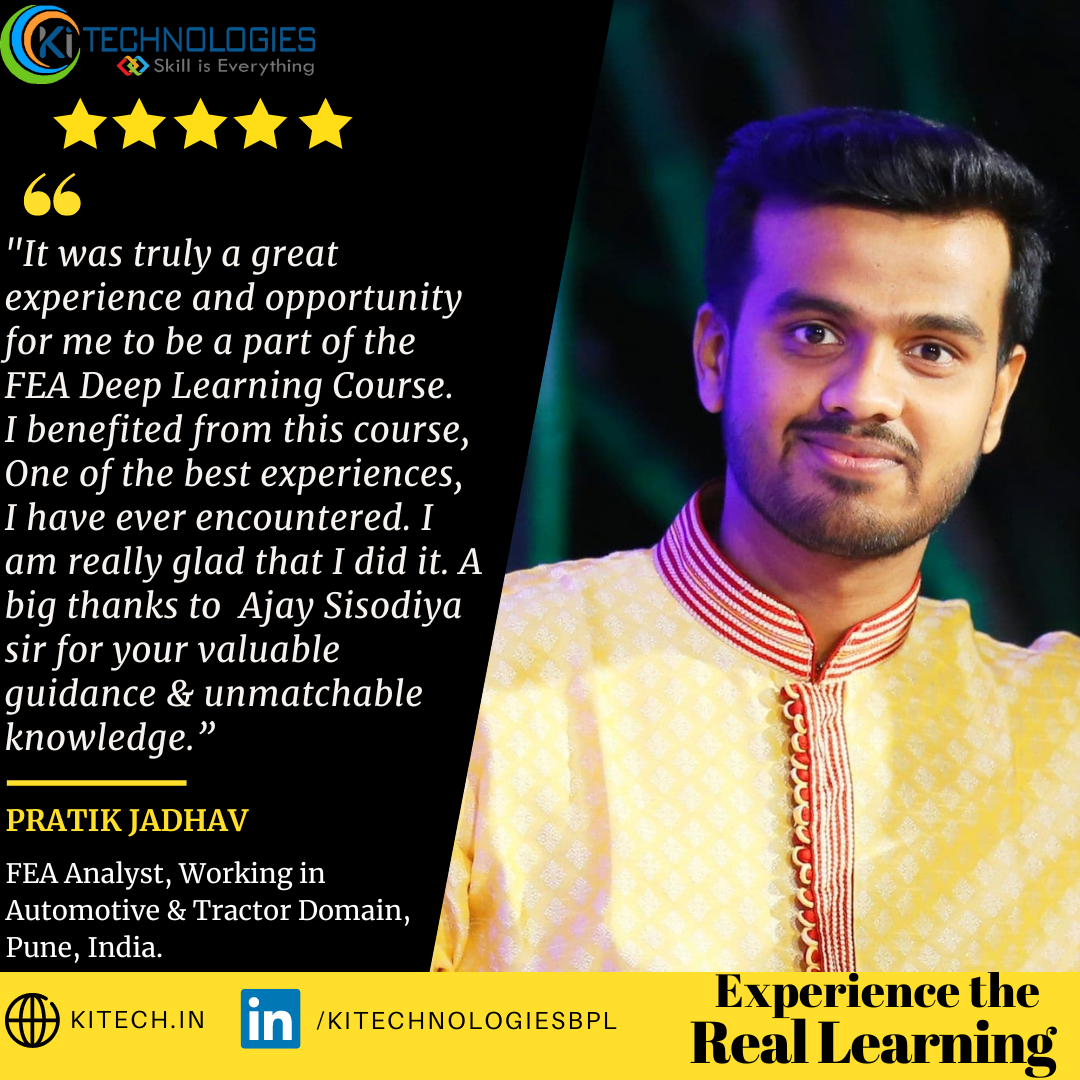
Feedback published by KI Technologies from previous training batches.
Choose the fee applicable to your location and complete registration on the official course website.
For learners in India.
For learners outside India.
Start learning after completing registration. Confirm the final payable fee on the official enrollment page.
Everything you need to know about access, mentoring, schedule and enrollment.
The course uses recordings of real live training sessions, including learner questions and engineering discussions. An optional live doubt-clearing session is offered on Saturdays.
The planned learning duration is two months.
Five recorded sessions are provided every week, Monday to Friday, one session per day.
Yes. You can watch or download the recorded sessions according to your schedule.
Yes. A dedicated Telegram group provides ongoing guidance and direct expert support. Optional Saturday live doubt-clearing lasts 30 minutes.
Yes. Lifetime access includes recorded sessions, technical PDFs and design files.
The course covers 11 analysis types, from linear static and non-linear analysis through thermal, dynamic, vibration and fatigue fundamentals. The detailed syllabus is available to download.
The course covers FEA fundamentals before progressing to applied project work. Engineering students and working professionals can review the syllabus to assess suitability.
The standard fee is ₹35,500 for domestic candidates and ₹60,000 for international candidates. Check the official registration page for the final payable amount.

Use the registration button to continue to the official KI Technologies course page. Once registration is completed, you can start learning.
Review the syllabus, then continue to the official course registration.